How to become a full-stack developer (outlining key roles, competencies, and a learning roadmap)
Learn how to become a full-stack developer with our comprehensive guide outlining essential roles, required competencies, and a practical step-by-step learning roadmap.
What Is a Full-Stack Developer?
A full-stack developer is someone skilled enough to work on both the front-end (user interfaces) and back-end (servers, databases, APIs, deployment) of web applications. In other words, they’re versatile professionals capable of managing every stage of a project—from initial planning to final implementation—entirely on their own.
But with technology trends evolving quickly, full-stack developers have become even more valuable due to their versatility. They can smoothly switch between front-end and back-end roles, making them essential team members. In this article, we’ll clearly define what a full-stack developer is, what they do, the skills needed, and provide a practical roadmap for becoming one!
Defining a full-stack developer
A full-stack developer is a developer who can work on both the front-end and back-end of web and apps. They have the ability to work on everything from interfaces that directly interact with users (front-end) to servers, database management, API development, and deployment (back-end). They're literally a jack-of-all-trades who can single-handedly complete the final implementation.
Becoming a full-stack developer requires a solid understanding and hands-on experience in both front-end and back-end technologies. It can certainly be challenging to master both areas, but once you do, you'll enjoy greater opportunities, career flexibility, and the potential to grow quickly into leadership roles.
Being a true full-stack developer isn't simply about knowing everything superficially—it's about effectively integrating multiple technologies and connecting front-end and back-end seamlessly.
It's more than just being able to do all areas of the backend and frontend,
to be a true full-stack developer.
Full-Stack vs. Front-End/Back-End Developers
Here's a quick summary of how a full-stack developer differs from typical front-end or back-end developers:
Aspect | Full-Stack Developers | Front-End/Back-End Specialists |
|---|---|---|
Scope | Covers both front-end and back-end | Specializes in either front-end or back-end |
Tech Stack | React, Node.js, Django, MongoDB, etc. | React, Vue.js (Front-End) / Spring, MySQL (Back-End) |
Pros | Highly flexible, great for rapid prototyping | Deep expertise in a specific technology area |
Cons | Difficult to achieve depth in all technologies | Greater dependence on collaboration |
Essential Skills for Full-Stack Developers
To become a successful full-stack developer, you need to master not only front-end and back-end technologies but also the tools and environments that connect these two domains. Rather than overwhelming yourself by learning everything at once, start by building a strong foundation in core front-end and back-end skills, then gradually connect and integrate your knowledge.

1️⃣ Essential Front-End Skills
Basic Web Technologies: HTML, CSS, JavaScript
Frameworks/Libraries: React, Vue.js, Angular
UI/UX Collaboration Tools: Figma, Adobe XD
2️⃣ Essential Back-End Skills
Programming Languages: Node.js, Python, Java
Frameworks: Express.js, Django, Spring Boot
Databases: MySQL, PostgreSQL (RDBMS), MongoDB (NoSQL)
API Development: RESTful APIs, GraphQL
3️⃣ Collaboration Basics
Version Control: Git, GitHub
Communication Tools: Slack, Jira, Trello
4️⃣ DevOps Essentials
Deployment & CI/CD Tools: Jenkins, GitHub Actions, Docker
Cloud Services: AWS, Netlify
Full-stack development learning roadmap
To become a full-stack developer, it’s important to learn gradually and systematically—from basic to advanced skills. Start with fundamentals like HTML and CSS, then progressively add front-end and back-end knowledge, database management, and cloud deployment techniques. Gain DevOps skills and gather practical experience through real-world projects.
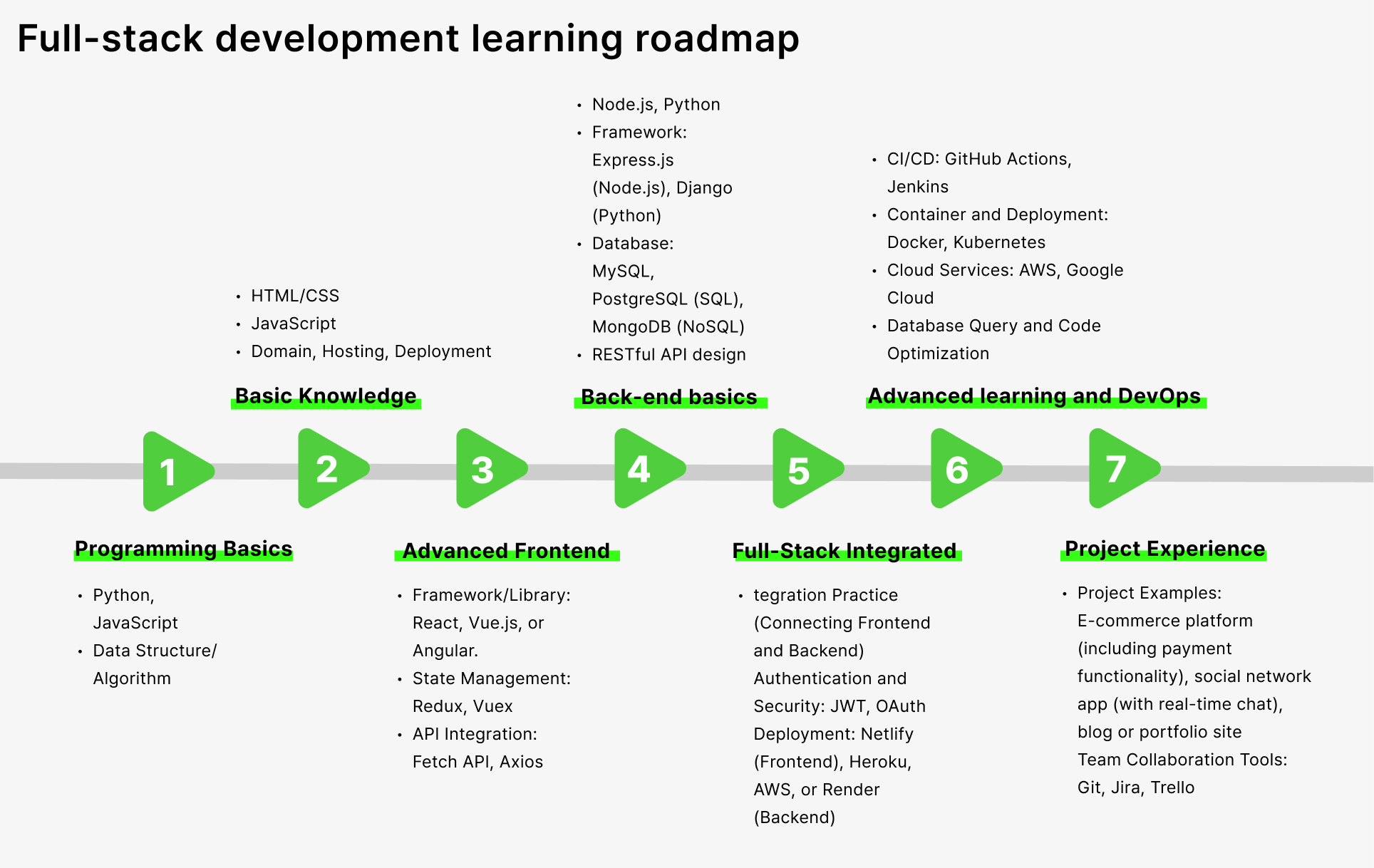
Here's a simplified roadmap:
Foundation: HTML, CSS, JavaScript basics
Front-End Development: React, Vue.js, Angular, responsive design, UI/UX concepts
Back-End Development: Node.js, Python, Java frameworks, database design, API creation
Collaboration and Tools: Git, GitHub, Jira, Slack
Deployment & Operations: AWS, Docker, CI/CD (Jenkins, GitHub Actions)
Real-World Project Experience: Build and deploy your own projects to develop practical expertise
A full-stack developer brings multiple technologies together, managing all aspects of web application development. It’s not an easy path, but it’s extremely rewarding, offering plenty of opportunities for growth and leadership.
Demand for full-stack developers will only continue to rise. As technology progresses, this skill set opens numerous career possibilities. Start building your skills step-by-step and gain valuable practical experience through real projects.
Ready to take your first steps? Begin your journey today with Codetree’s free Codetree 101 course! Codetree is here to guide and support your developer career, every step of the way!
Comments 0
0/2000
More articles
Front End vs Back End: Which Path is Right for You?

Interview Problem Explained: Guess Number Higher or Lower II(LeetCode 375, Minimax & Dynamic Programming)

Interview Problem Explained: Guess Number Higher or Lower (LeetCode 374, Binary Search)

Interview Problem Explained: To Lower Case (LeetCode 709, String Manipulation & ASCII Code)
Tech Career Insights
- Front End vs Back End: Which Path is Right for You?
- How to become a full-stack developer (outlining key roles, competencies, and a learning roadmap)