Interview Problem Explained: Guess Number Higher or Lower (LeetCode 374, Binary Search)
Master the Guess Number Higher or Lower problem with binary search. Learn how to optimize guessing games, analyze time complexity, and prepare for coding interviews with step-by-step solutions.
What You’ll Learn from This Interview Prep Article
Level: Intermediate | Reading Time: ~5 minutes
Key Concepts: Binary Search
How to logically structure a problem
How to identify inefficiencies and improve your approach
How to leverage problem properties to derive the binary search idea
How to analyze time and space complexity
How to strengthen your real-world problem-solving skills
Guess Number Higher or Lower: Problem Statement
This problem is a simple number guessing game. The system secretly picks a number (pick) between 1 and n. You can call a predefined function guess(num) to find out if your guess (num) is higher, lower, or equal to pick. Your goal is to find pick using the minimum number of calls to guess.
The guess(num) function returns:
1: Your guessnumis higher thanpick.1: Your guessnumis lower thanpick.0: Your guessnumis equal topick.
Tip: This is LeetCode Problem 374. LeetCode’s problem statements are often concise and may confuse learners. Codetree provides additional explanations and examples for deeper understanding.
Step 1. Naive Approach
Idea
What’s the most straightforward solution? Simply try every number from 1 to n, calling guess() for each one. This is a linear search approach: "Is it 1? Is it 2? Is it 3? ..."—checking every possibility in order.
Logic Breakdown
Loop through every number
kfrom 1 ton.For each
k, callguess(k).If
guess(k)returns0, thenkis the answer. Returnkand stop searching.
Code Implementation
def guessNumber(self, n: int) -> int:
    # Check every number from 1 to n sequentially.
    for k in range(1, n + 1):
        # Call guess(k) to check if it's the answer.
        if guess(k) == 0:
            # If found, return k.
            return k
Time & Space Complexity Analysis
Time Complexity: O(n) In the worst case (if the answer is
n), you must callguess()ntimes. Sincencan be as large as 2^31−1, this approach leads to excessive calls and will cause a time limit exceeded error.Space Complexity: O(1) Only the loop variable
kis used; no extra memory is required.
Step 2. Binary Search Approach
Idea
The problem with Step 1 is that it makes too many unnecessary guesses.
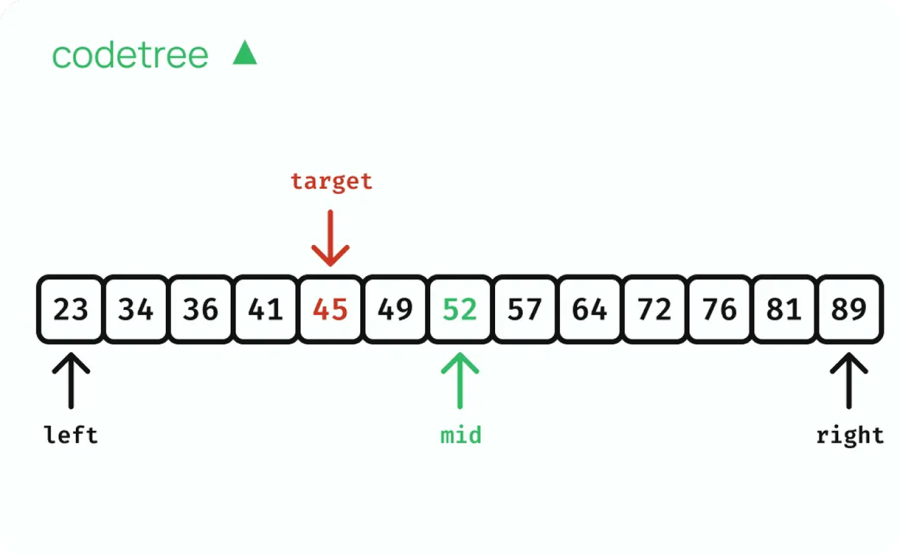
The guess() function doesn’t just say "right or wrong"—it tells you if your guess is too high or too low. This directionality allows you to drastically reduce the search space. Since the numbers are sorted, you can apply binary search: always guess the middle value, and use the result to discard half the remaining possibilities each time.
The key idea: "From the current possible range, guess the middle number, and use the result to halve the search space."
Logic Breakdown
Set the search range from
left = 1toright = n.While
leftis less than or equal toright(i.e., the search space is valid):Compute the midpoint:
mid = (left + right) // 2.Call
guess(mid)and store the result inres.Adjust the search range based on
res:If
res == 0(correct): Returnmid.If
res == 1(guess is too high): Move the search range to the left (right = mid - 1).If
res == -1(guess is too low): Move the search range to the right (left = mid + 1).
Code Implementation
def guessNumber(self, n: int) -> int:
    left, right = 1, n

    # Continue while the search range is valid
    while left <= right:
        # In Python, integer overflow isn't an issue, so this is safe
        mid = (left + right) // 2
        res = guess(mid)

        if res == 0:
            # Found the answer
            return mid
        elif res == 1:
            # Guess is too high; discard left half
            right = mid - 1
        else:  # res == -1
            # Guess is too low; discard right half
            left = mid + 1
Time & Space Complexity Analysis
Time Complexity: O(log n) Each step halves the search range. The number of steps needed to reduce
nto 1 is proportional to log n. Thus, the time complexity is O(log n), making it extremely fast even for largen.Space Complexity: O(1) Only a few variables (
left,right,mid) are used.
To practice: Quickly Find Numbers
Frequently Asked Questions
Q: Why do we use while left <= right instead of while left < right?
A: When left == right, there’s only one value left to check — it could be the answer. Skipping it would cause errors.
Q: Why use while left <= right instead of while left < right?
A: When left equals right, there is only one number left to check, which could be the answer. We must check this final value.
Q: Can this be implemented recursively?
A: Yes, but an iterative solution is often preferred to avoid stack overflow on large inputs.
How to Prepare for Interviews with the Guess Number Higher or Lower Problem
This problem is commonly used in interviews to assess your basic algorithm knowledge and problem-solving skills.
Pattern Recognition: When you see "find a value in a sorted range," you should immediately think of binary search. Here, the range from 1 to
nis implicitly sorted.Clear Communication: Practice explaining: "Linear search is O(n) and inefficient. Since
guess()provides direction, we can optimize to O(log n) using binary search."Boundary Handling: Many mistakes in binary search come from incorrectly updating
left,right, or the loop condition. Understand and be able to explain why you useleft <= rightand how you update the boundaries.Extensions: Binary search can be adapted to find the first/last occurrence, search for a condition, or optimize thresholds. Master the core logic so you can adapt to these variants.
Similar Problems to Practice
How to review after solving this problem:
Finding other problems that require searching for a value or condition in sorted data, and think about how to adapt the
left,right, andmidlogic.Summarizing the solution in one sentence (e.g., "Optimized linear search from O(n) to O(log n) using binary search and directional feedback.").
Manually tracing how
left,right, andmidchange for smalln(e.g., 10) to deepen your understanding of boundary handling.
Coding Interview Prep Guide
What you must know for real interviews:
Recognize when binary search is applicable for sorted search spaces
Use directional information from helper functions (like
guess(num)) to optimize searchAdjust search boundaries (
left,right) and conditions for O(log n) efficiency
What you should be able to explain:
"How does the feedback from
guess()allow us to optimize the search?""How do you set and update
left,right, andmidin binary search? Why useleft <= right?""Why does binary search achieve O(log n) time complexity?"
Understanding mathematical rules is the foundation of algorithmic thinking:
This problem is a classic example of reducing search in a sorted range to O(log n) using binary search.
Manually tracing small examples helps solidify your understanding of boundary logic.
Recognize the pattern of "reducing the search space based on conditions" and apply it to other optimization/search problems.
Comments 0
0/2000
More articles
Interview Problem Explained: Guess Number Higher or Lower II(LeetCode 375, Minimax & Dynamic Programming)

Interview Problem Explained: To Lower Case (LeetCode 709, String Manipulation & ASCII Code)
Interview Problem Explained: Minimize String Length (LeetCode 2716)
Interview Problem Explained: Nim Game (LeetCode 292, Recursion & Memoization)
Coding Interview Prep
- Interview Problem Explained: Guess Number Higher or Lower II(LeetCode 375, Minimax & Dynamic Programming)
- Interview Problem Explained: Guess Number Higher or Lower (LeetCode 374, Binary Search)
- Interview Problem Explained: To Lower Case (LeetCode 709, String Manipulation & ASCII Code)
- Interview Problem Explained: Fibonacci Number (LeetCode 509, DP & Memoization)

- Interview Problem Explained: Minimize String Length (LeetCode 2716)