Interview Problem Explained: Climbing Stairs (LeetCode 70, Recursion & DP)
Learn how to solve the “Climbing Stairs” problem (LeetCode 70) with recursion, memoization, and tabulation. This beginner-friendly guide breaks down dynamic programming concepts and time complexity step-by-step for tech interview prep.
What You’ll Learn from This Interview Prep Article
Level: Intermediate | Reading Time: 15–20 mins
Key Topic: Recursion, Dynamic Programming
Understand the Climbing Stairs problem using basic recursion
Learn why naive recursion is inefficient and how to optimize it
Improve time complexity using memoization
Learn how to apply tabulation to reduce complexity from O(2ⁿ) to O(N)
Strengthen your algorithm design skills for coding interviews
Climbing Stairs: Problem Statement
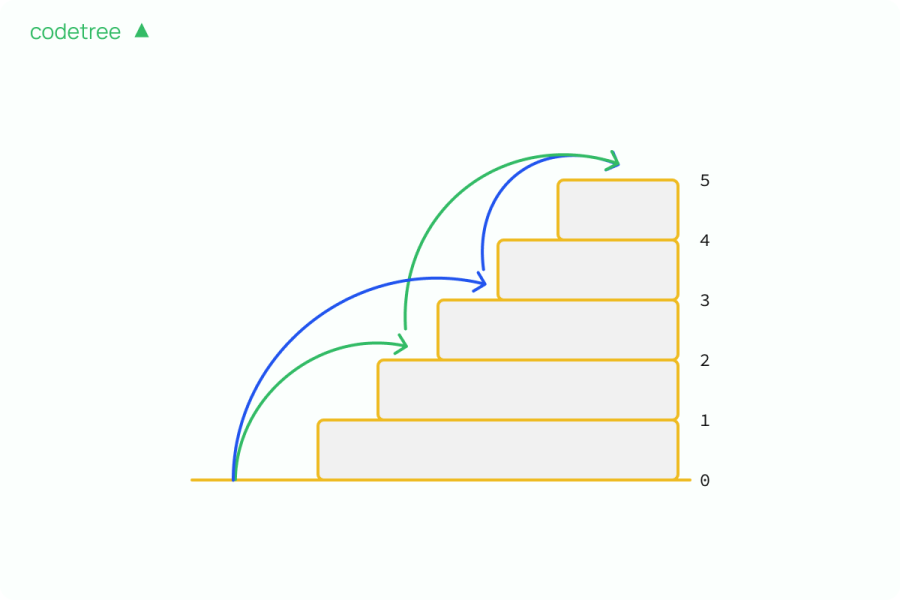
Your are faced with a challenge: climb to the top of a staircase with N steps. Each time, you can climb either 1 or 2 steps. Given N, calculate the total number of distinct ways to reach the top.
Examples:
N = 2: [1+1], 2 → 2 ways
N = 3: [1+1+1], [1+2], [2+1] → 3 ways
N = 4: [1+1+1+1], [1+1+2], [1+2+1], [2+1+1], [2+2] → 5 ways
Constraints:
1 ≤ N ≤ 45
Tip: This is LeetCode Problem #70.
LeetCode’s problem statements are often concise, which can leave some concepts unclear.
Here at Codetree, we break things down with examples and step-by-step guidance for deeper understanding.
Step 1: Naive Recursive Approach (O(2ⁿ))
Idea
Why use recursion? Recursion is the most intuitive way to break a problem into smaller subproblems. The simplest method is to count all possible ways directly using recursion.
Reduce the "remaining steps" with each recursive call. The function takes the number of remaining steps n as its parameter.
Logic Breakdown
Base cases for the recursive function:
n = 0: Reached the top → count 1 way
n = 1: One step left → only one way to finish
Code Implementation
answer = 0
def climb_stairs(n):
    global answer
    if n == 0 or n == 1:
        answer += 1
        return
    climb_stairs(n-1)  # Take 1 step
    climb_stairs(n-2)  # Take 2 steps
Time & Space Complexity
The recursion tree for N=5 looks like this:
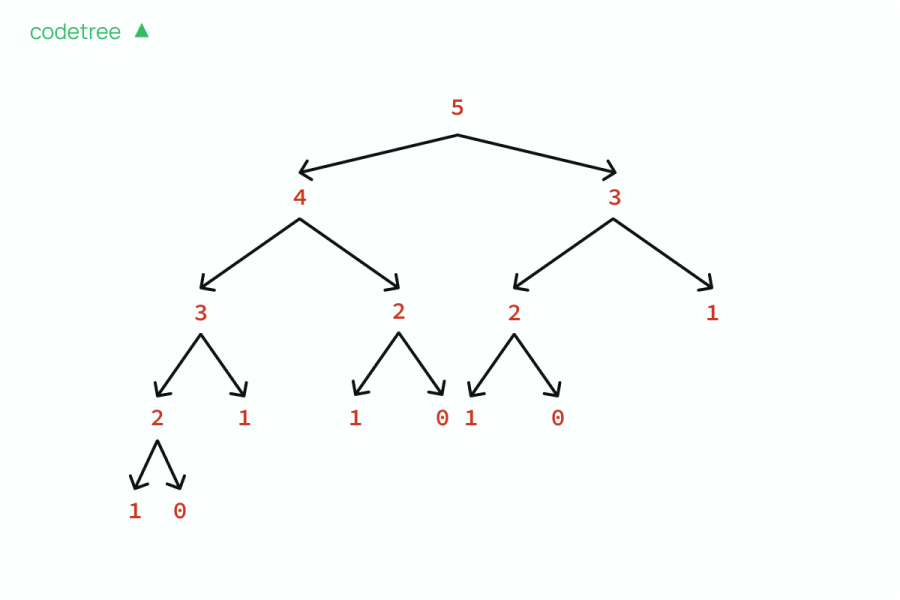
Each level makes 2 recursive calls. So the time complexity is O(2ⁿ).
For N = 45, this results in ~35 trillion calls — guaranteed timeout.
Step 2: Recursive Return Value
Idea
In Step 1, we used a global variable to count the number of ways. Now, let’s compute the result using return values instead. This helps set up for a future DP transformation.
Logic Breakdown
def climb_stairs(n):
    if n == 0 or n == 1:
        return 1
    return climb_stairs(n-1) + climb_stairs(n-2)
Return 1 for n == 0 or n == 1
Otherwise, return the sum of ways from n-1 and n-2
This structure eliminates the need for a global variable, making the code cleaner and easier to upgrade to DP.
Step 3. Memoization (Top-Down DP)
Idea
In the recursion tree, calls like climb_stairs(3) and climb_stairs(2) are repeated many times.
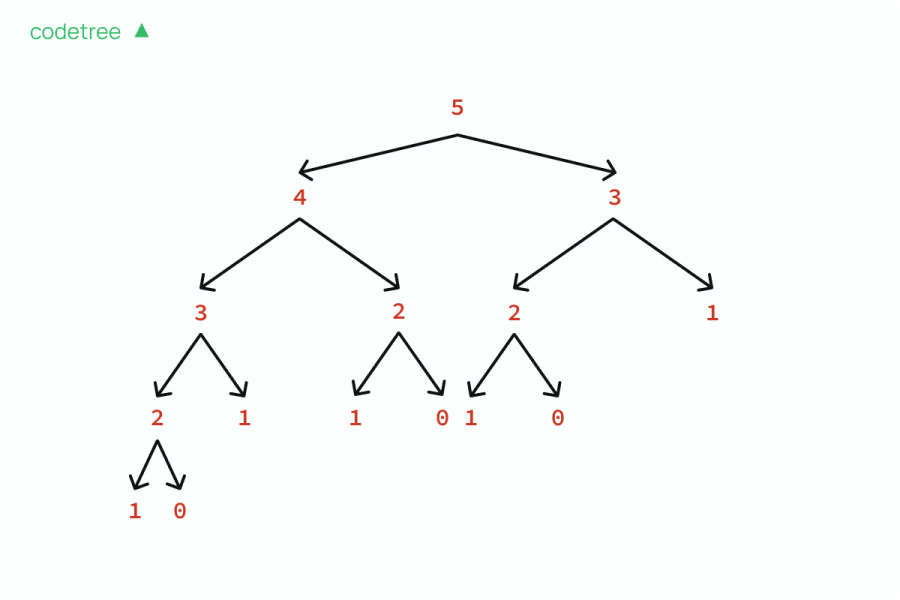
This redundant computation explodes as N increases, leading to O(2ⁿ) time complexity.
Dynamic Programming (DP) eliminates redundant work by storing results of subproblems and reusing them.
What is Memoization?
Memoization means caching the results of expensive function calls and returning the cached result when the same inputs occur again. This avoids repeated calculations and greatly improves efficiency.
Let’s apply memoization to the Climbing Stairs problem.
Logic Breakdown
Eliminate redundant computations
Store the result of
climb_stairs(k)once it's calculated, and reuse it when the same input appears again.
Memoization
Prepare a memo (e.g., a
memodictionary) to store previously computed results.If the result for
nis not in the memo, calculate it recursively and store it.If it is already stored, return
memo[n]directly without further recursion.
→ By avoiding redundant computations, we can reduce the time complexity from O(2ⁿ) to O(N).
Code Implementation
memo = {}
def climb_stairs(n):
    if n == 0 or n == 1:
        return 1
    if n not in memo:
        memo[n] = climb_stairs(n-1) + climb_stairs(n-2)
    return memo[n]
Time & Space Complexity
Time Complexity: O(N) Each state is computed only once.
Space Complexity: O(N) For the recursion stack and memoization storage.
Step 4. Tabulation (Bottom-Up DP)
Idea
Memoization solves the problem from the top down-starting with the big problem and recursively solving smaller ones.
Tabulation is the opposite: it solves from the bottom up, building solutions to small subproblems first and combining them to solve the original problem.
For Climbing Stairs, you precompute the number of ways to reach steps 1 and 2, then use those to compute steps 3, 4, ..., N in order.
Tabulation is fast, stable, and easy to implement with loops.
Key Elements of Tabulation
When solving a dynamic programming (DP) problem using tabulation, there are three essential components you need to define:
State Definition (DP Definition):
This plays the same role as the
memoin the memoization approach.You must decide what value to store and how to use it.
In this problem, we define it as: →
dp[i] = the number of distinct ways to reach the i-th stair.
Recurrence Relation:
This expresses the relationship between the current state and its previous states using a formula.
For this problem, the recurrence is: →
dp[i] = dp[i-1] + dp[i-2]Because the number of ways to reach the i-th stair equals: (ways to reach the (i-1)-th stair and take one step) + (ways to reach the (i-2)-th stair and take two steps).
Base Cases:
These are the smallest subproblems that cannot be broken down further and must be manually defined.
For this problem: →
dp[0] = 1(One way to stay at the base without climbing) →dp[1] = 1(One way to climb directly to the first stair)
See also: Fibonacci Number DP
Code Implementation
def climb_stairs(n):
    # Exception handling
    if n <= 1:
        return 1

    # Initialize the dp array
    dp = [0] * (n + 1)
    dp[0] = 1  # Set base case
    dp[1] = 1  # Set base case

    # Fill values using Bottom-up approach
    for i in range(2, n + 1):
        dp[i] = dp[i-1] + dp[i-2]  # Apply recurrence relation

    return dp[n]  # Return the result
Time & Space Complexity
Time Complexity: O(N)
Each value from 2 to N is computed exactly once, resulting in a total of N - 1 operations.
Space Complexity: O(N)
A
dparray of length N + 1 is used, so the space requirement is proportional to N.
Tabulation is simple, intuitive, and avoids redundant calculations-making it ideal for this problem.
Frequently Asked Questions
Q. Why is the recursive approach inefficient?
A: While recursion is intuitive, it incurs heavy time and memory overhead due to repeated subproblem calls. This is especially problematic when the same subproblem is solved many times.
Q. Memoization vs. Tabulation: Which is better?
A: Tabulation is generally faster and more predictable, as it uses loops instead of recursion. However, for complex state spaces, memoization can be easier to implement. Choose the method that best fits the problem.
Q. What type of algorithm is this problem?
A: This is a classic dynamic programming problem with a recurrence similar to the Fibonacci sequence. It’s perfect for practicing state definition, recurrence, and base cases.
How to Prepare for Interviews with the Climbing Stairs Problem
The ‘Climbing Stairs’ problem is a textbook example of how to evolve your thinking from recursion to memoization to tabulation.
By working through each approach, you’ll internalize key DP concepts: eliminating redundant work, defining states, and building recurrence relations.
Practice these skills:
Understand the structural inefficiency of naive recursion
Learn how memoization and tabulation improve performance
Strengthen your intuition for recurrence relations and base cases
Similar problems to practice
How to Review After Solving This Problem
Comparing time complexities Try different N values and see the performance gap.
Solving the problem in all three ways Focus on the core idea, not just the code.
Coding Interview Prep Guide
Key Concepts You Must Know for Real Interviews:
Recursion Fundamentals
Memoization vs. Tabulation
Dynamic Programming (DP) Principles
What you should be able to explain:
Why is the Climbing Stairs problem structurally similar to the Fibonacci sequence?
Why is the naive recursive solution O(2ⁿ)?
Can you describe the difference between memoization and tabulation, both in code and logic?
Why are the base cases
dp = 1anddp[1] = 1in tabulation, and what do they mean?
Interview tips:
Start with the simplest approach, then show how you recognize and optimize inefficiencies.
Focus on explaining your thought process for improving complexity.
Clearly state the moment and reason for switching to a better approach.
It’s not just about getting the right answer-be able to explain why your solution is optimal.
Comments 0
0/2000
More articles

Interview Problem Explained: Guess Number Higher or Lower II(LeetCode 375, Minimax & Dynamic Programming)

Interview Problem Explained: Guess Number Higher or Lower (LeetCode 374, Binary Search)
Interview Problem Explained: Matrix Diagonal Sum (Array, Matrix)

Interview Problem Explained: To Lower Case (LeetCode 709, String Manipulation & ASCII Code)
Coding Interview Prep
- Interview Problem Explained: Ransom Note (LeetCode 383, String Manipulation & Counting Array)

- Interview Problem Explained: Nim Game (LeetCode 292, Recursion & Memoization)
- Interview Problem Explained: Find the Maximum Achievable Number (LeetCode 2769)

- Interview Problem Explained: Climbing Stairs (LeetCode 70, Recursion & DP)
- Interview Problem Explained: Matrix Diagonal Sum (Array, Matrix)